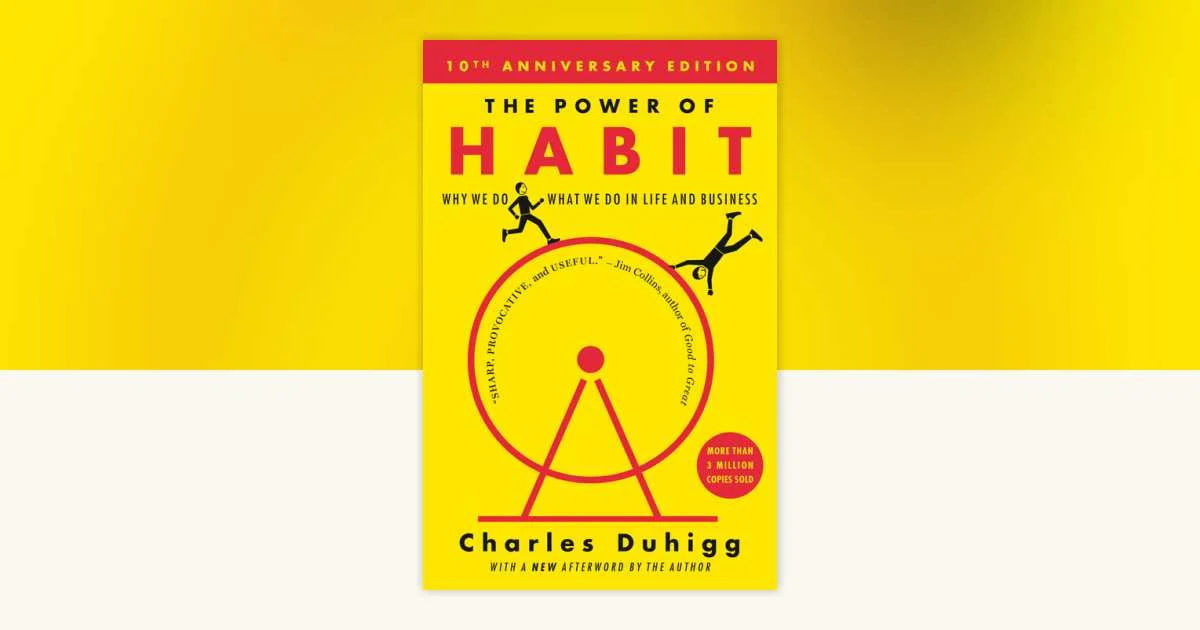
Charles Duhigg’s The Power of Habit gave the world a diagram that fits comfortably on a napkin:
cue → routine → rewardThat simplicity is why the habit loop became popular. It is also why it gets stretched into explanations it cannot carry.
The loop is a useful diagnostic model. It helps you stop calling a behavior “bad discipline” and start asking what triggers it, what action follows, and what payoff keeps the route available.
The habit loop
Imagine you open social media every time a work task becomes uncomfortable.
- Cue: uncertainty or boredom.
- Routine: open the feed.
- Reward: quick novelty and temporary escape.
The cue is not necessarily a notification. The reward is not necessarily pleasure. It may be relief.
That distinction matters. Blocking the app adds friction, but if the real problem is escaping uncertainty, the urge may migrate to email, news, or an urgent need to research office chairs.
Duhigg describes the three-part loop in an official sample chapter. The model is explanatory shorthand, not a claim that researchers diagnose every repeated behavior with exactly three boxes.
What research says about cues and context
In a study of students changing universities, exercise, newspaper-reading, and television habits were more disrupted when their associated contexts changed. Changed intentions alone did not explain the pattern.
A review by Wood and Neal likewise describes habits as learned context–response associations. Goals may motivate early repetition, while familiar cues increasingly trigger established behavior.
This supports looking beyond time. Place, preceding action, people, tools, and emotional state can all be part of the context. Removing one notification may be insufficient when the cue is “I reach an uncertain paragraph.”
Craving connects the loop
Duhigg argues that anticipation of the reward helps drive the behavior. The cue begins to predict what comes next.
This does not mean every habit is a dopamine button or that one neurotransmitter explains behavior. “Dopamine” is often used online as a scientific-looking synonym for “I wanted it.”
The practical point is simpler: repeated pairings can make a cue feel like a request.
Craving is also difficult to infer from behavior alone. Record competing reward hypotheses rather than declaring the first story true. The afternoon snack may provide energy, a break, sensory pleasure, or permission to leave the desk.
How to run a reward experiment
If you want to understand a routine, keep the cue roughly the same and test different rewards.
For an afternoon snack:
- eat a planned snack;
- take a five-minute walk;
- talk to someone;
- make tea;
- step away from the screen.
After each alternative, notice whether the urge remains.
This is not a perfect laboratory. It is a way to distinguish hunger from boredom, a break, social contact, or relief.
Change one reward at a time and review the urge after a comparable interval. Keep safety and health boundaries: food, substance use, medication, or distressing behavior may require professional guidance rather than a self-experiment.
Self-assigned rewards have limited evidence. A systematic review found a small average effect and few eligible studies, with insufficient evidence for several kinds of self-incentive. A reward is a hypothesis, not automatic reinforcement.
Replace the routine—and change the environment
The book’s best-known rule is to keep the cue and reward while replacing the routine.
Sometimes that works. Sometimes the better intervention is to remove the cue, reduce exposure, or redesign the context.
| Problem | Replacement | Environment change |
|---|---|---|
| Doomscrolling in bed | Read two pages | Charge phone outside the bedroom |
| Snacking while working | Tea and a real break | Keep snacks out of reach |
| Avoiding a report | Write one rough paragraph | Leave the document open at the next step |
Replacement gives the old request a new answer. Environment design reduces how often the request arrives.
Duhigg’s “golden rule” is to keep the cue and reward while changing the routine; the author’s official study guide presents that formulation.
In practice, all three elements can change. Moving the phone changes the cue environment. Taking lunch away from the desk changes context. Asking for clearer requirements changes the uncertainty that prompted escape. Use the least harmful effective change rather than preserving the diagram.
Keystone habits are not universal dominoes
Exercise, family meals, planning, or sleep can influence other behaviors. Duhigg calls these keystone habits.
The concept is useful for finding high-leverage actions. But a morning walk does not automatically fix finances, relationships, and email.
A candidate keystone habit should show evidence in your life:
- it improves several downstream choices;
- it is realistic enough to repeat;
- losing it reliably makes other things harder.
Test the spillover instead of assuming it.
Write the expected downstream effects and review them separately. If morning planning improves first-task clarity but does not affect sleep or spending, it may be useful without being a universal keystone.
Avoid choosing a high-status action merely because books call it foundational. The best leverage point may be medication adherence, a care arrangement, or reducing an impossible workload.
The loop is not the whole person
Behavior is also shaped by goals, identity, skills, stress, resources, relationships, and institutions.
Some repeated behaviors are not automatic habits. They may be deliberate coping strategies or responses to difficult conditions. Reframing every problem as a cue-routine-reward loop can hide what actually needs to change.
Use the loop where it increases precision, not where it shrinks the story.
Why old patterns can return
MIT research on repeated action sequences showed how behavior can become “chunked” around the beginning and end of a routine. A popular MIT account also describes the return of an old pattern when a reward reappeared.
That helps explain why a long quiet period is not proof that a route was erased. Stress, location, people, or reward availability can restore the old context. Prepare a return rule and reduce access rather than interpreting recurrence as total failure.
Not all repetition is habit
A scientific review of the habit concept cautions that definitions and measures vary and many studies rely on self-report or correlation. Repetition can remain deliberate, constrained, or goal-directed.
Before applying the loop, ask whether the behavior is automatic in a recurring context or a conscious response to conditions. A worker checking messages because the employer requires instant replies does not merely have a personal notification habit.
The Power of Habit versus Atomic Habits
Duhigg is stronger as an investigative narrative: locate cue, routine, reward, and possible leverage. James Clear’s Atomic Habits is stronger as a compact design manual around cues, friction, environment, identity, and small action.
Both simplify a large research field. Use Duhigg when you need to understand an existing pattern and Clear when you need practical design prompts. Neither book replaces domain-specific evidence or care.
A practical change plan
- Choose one repeated behavior.
- Record when and where it happens.
- Identify the likely cue.
- Test several possible rewards.
- Choose a replacement routine.
- Add friction to the old route.
- Make the replacement easy.
- Review the pattern after two weeks.
Plan the return after a lapse. One repetition of the old behavior is data, not restoration of the original factory settings.
Using the habit loop in Flammy
Write the replacement behavior, not “stop being bad.”
Example:
- cue: finish dinner;
- old routine: open short videos;
- replacement: read two pages;
- minimum: one paragraph;
- feedback: XP and a visible check.
Flammy records the replacement and makes repetition visible. You still need to discover the cue and reward.
The verdict
The Power of Habit is strongest as a set of investigative questions:
- What happened immediately before?
- What did the behavior provide?
- What could provide a similar result with a lower cost?
- What in the environment keeps the old route easy?
The loop is not a complete theory of human behavior. It is a good place to begin looking.
Related reading
- Continue with our evidence-based Atomic Habits review.
- Continue with how habits form.
Give one old cue a better response. Add the replacement behavior in Flammy, keep the minimum small, and observe what actually satisfies the urge.
Build a replacement habit in Flammy