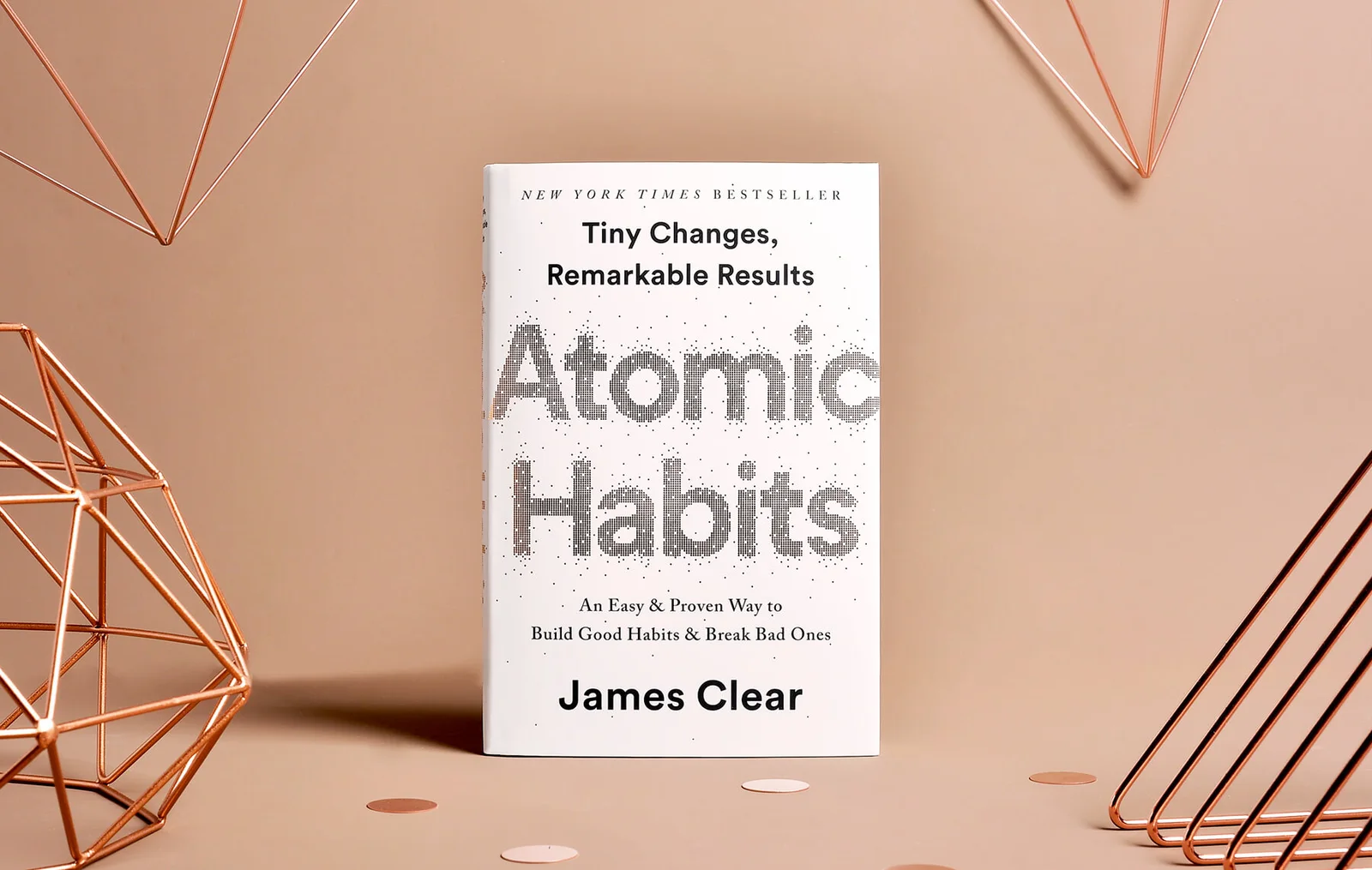
Most people meet Atomic Habits through a quote card. Get one percent better. Focus on systems, not goals. Never miss twice. Become the kind of person who does the thing.
The full book is more useful than the quote cards, but also less magical. James Clear did not discover a secret law that makes every tiny action compound like an index fund. He assembled several sensible ideas about cues, friction, repetition, and feedback into a framework people can remember.
That is the real achievement of the book. It turns behavior change into something you can adjust, rather than a personality test you keep failing.
The short version
Clear’s four laws of behavior change are:
| To build a behavior | To reduce a behavior |
|---|---|
| Make it obvious | Make it invisible |
| Make it attractive | Make it unattractive |
| Make it easy | Make it difficult |
| Make it satisfying | Make it unsatisfying |
This is a checklist, not a brain scan. A behavior may fail because the cue is missing, the first step is too large, the payoff is distant, or the environment keeps offering an easier alternative.
The framework helps you ask a better question. Not “Why am I so undisciplined?” but “What in this setup makes the action unlikely?”
The best idea in the book is environment design
We like to imagine behavior begins with a clear decision. In practice, the room often votes first.
The guitar in its case loses to the phone already in your hand. Water on the desk competes well with soda in another room. A document that opens on the exact paragraph you need is easier to resume than a project called “write report.”
Changing the environment does not remove choice. It changes which choice requires a committee meeting.
Useful examples:
- put medication next to something you already use every morning;
- keep the book visible and the streaming remote in a drawer;
- prepare workout clothes before the moment you expect yourself to exercise;
- block distracting sites during one protected work interval;
- leave a note describing the next action before closing a project.
The point is not to build a life with no temptation. It is to stop giving every temptation home-field advantage.
“Make it easy” does not mean “make it pointless”
The two-minute rule is often misunderstood as a productivity contest in miniature. Read one page. Put on your running shoes. Open the document.
The tiny version is not the entire ambition. It is the entry ramp.
| Vague ambition | Useful minimum |
|---|---|
| Work out every day | Do five minutes of mobility |
| Read more | Read two pages after lunch |
| Learn Spanish | Complete one short exercise |
| Write a book | Add 100 rough words |
A minimum works when it preserves the route to the larger behavior. If you keep checking off “open the document” and immediately close it, you have automated opening documents. Congratulations, technically.
Identity helps when it follows evidence
Clear suggests asking, “What would a healthy person do?” and treating each repetition as a vote for an identity.
This can be useful. “I am practicing being someone who writes regularly” is more stable than waiting for inspiration. But identity becomes brittle when it turns into a purity test.
One skipped workout does not prove you are not athletic. One distracted morning does not revoke your writer membership. Behavior is evidence, not a courtroom verdict.
A more forgiving version:
I am building a pattern, and today is one data point.
That leaves room to return.
How long does a habit take?
There is no universal number. The famous 66-day figure comes from a study in which the time to reach a plateau in automaticity varied dramatically across participants and behaviors. The average became a headline; the range was the more useful result.
Simple actions repeated in a stable context may become easier relatively quickly. Complex, infrequent, or emotionally difficult behaviors can remain effortful for much longer.
Track two things separately:
- Did I do it?
- Is it becoming easier to start without debate?
A streak answers the first question. It does not automatically answer the second.
Where Atomic Habits gets oversold
Tiny improvements do not always compound
Some skills compound. Some actions maintain a baseline. Some become obsolete. Ten minutes spent learning the wrong tool does not become valuable because you repeated it faithfully.
Direction matters before consistency.
Rewards can crowd out the point
Immediate feedback helps a delayed-payoff behavior feel real. But if the reward becomes the only reason to act, the system may collapse when the reward disappears.
Use rewards to support a meaningful action, not to bribe yourself into a life you dislike.
Systems cannot solve every constraint
A better morning routine does not create childcare, affordable healthcare, a sane workload, or control over shift schedules. Personal systems are useful inside real conditions; they do not make those conditions imaginary.
A practical seven-day setup
- Choose one behavior, not a complete personality renovation.
- Name the cue: after coffee, at 6 pm, when the laptop opens.
- Define the smallest version worth doing.
- Remove one obvious source of friction.
- Add immediate feedback: a checkmark, XP, or a note.
- Decide what happens after a miss.
- Review after a week and change the setup, not your self-respect.
Using the framework in Flammy
Flammy is useful for the feedback and visibility parts of the system:
- write the behavior as a concrete action;
- add a minimum version for low-energy days;
- award XP for the action, not for feeling motivated;
- choose a personal reward that actually feels rewarding;
- review the pattern instead of worshipping the streak.
For example, replace “become a reader” with “read five pages after dinner,” and let one page count on a difficult day. XP makes the repetition visible. It does not read the page for you or certify automaticity.
The verdict
Atomic Habits is a strong practical book because it makes behavior design memorable. Its four laws are best used as troubleshooting questions, not laws of nature.
Keep these parts:
- design the environment;
- reduce the first step;
- connect actions to stable cues;
- make progress visible;
- plan the return before you need it.
Leave the fantasy that every tiny action inevitably compounds into greatness. A small step is powerful when it is pointed somewhere useful and repeated under conditions you can live with.
Related reading
- Continue with how habits form.
- Continue with building a habit step by step.
Turn one useful idea into a behavior you can actually repeat. Add a concrete action in Flammy, give it a small minimum, and make the next repetition visible.
Build one atomic habit in Flammy