Stephen Covey’s The 7 Habits of Highly Effective People has a title that sounds as if a management consultant is about to optimize your breakfast.
The book itself is more thoughtful. Covey is less interested in squeezing extra tasks into a day than in deciding what kind of person makes the decisions. That is also the problem: “be proactive” is a valuable direction, but a terrible Tuesday task.
The book works best when its principles are translated into observable actions and worst when “effectiveness” becomes a moral ranking.
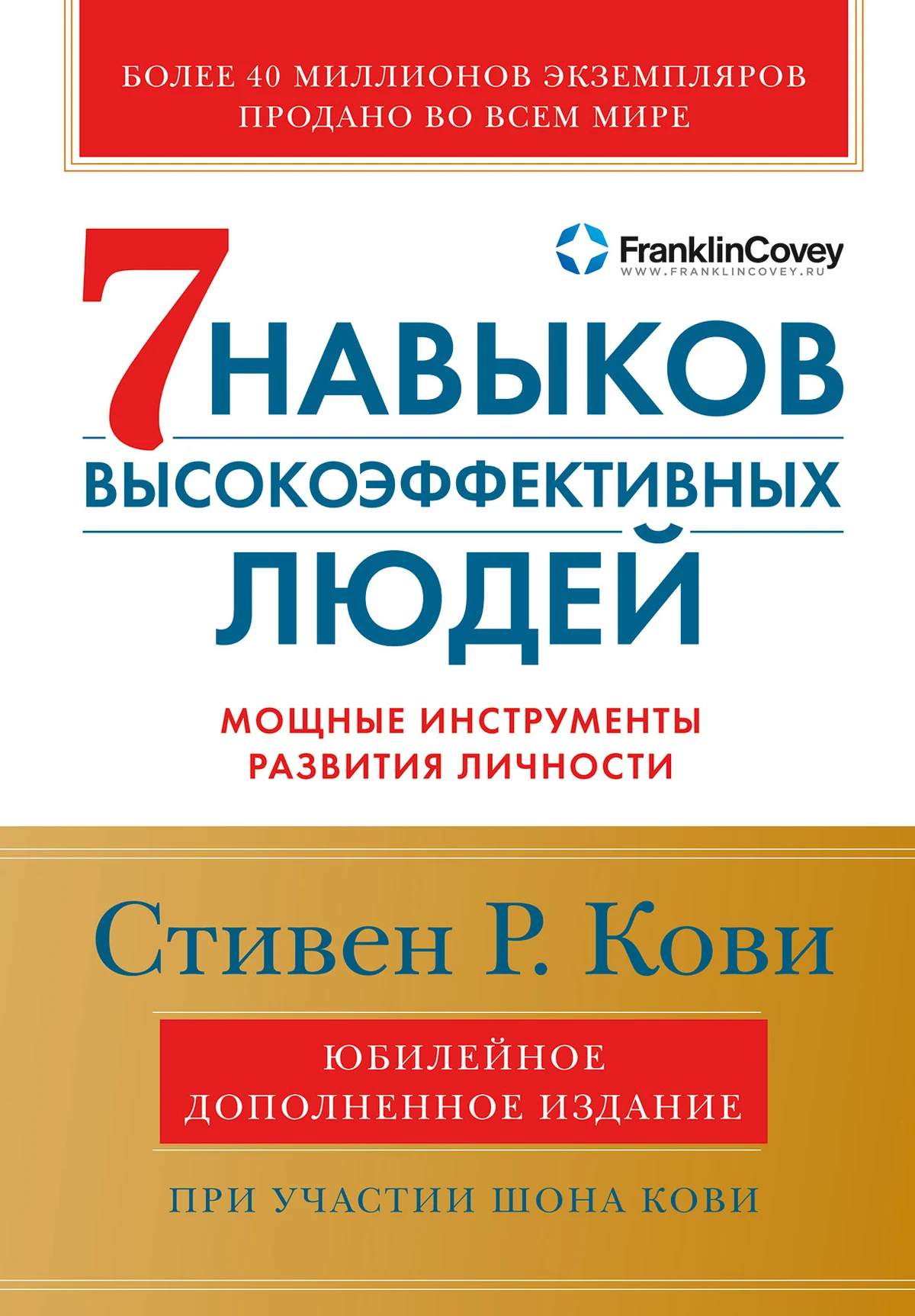
The seven habits in plain English
| Habit | Practical reading |
|---|---|
| Be proactive | Act on what you can influence |
| Begin with the end in mind | Define the result before choosing activity |
| Put first things first | Give important work protected time |
| Think win-win | Look for agreements that do not depend on hidden defeat |
| Seek first to understand | Listen well enough to update your view |
| Synergize | Use differences to improve the solution |
| Sharpen the saw | Maintain the person doing the work |
The first three concern personal direction, the next three concern relationships, and the seventh concerns renewal.
FranklinCovey’s official overview connects the habits with responsibility, goals, priorities, mutual benefit, understanding, collaboration, and renewal. This is an educational framework. It is not one scientifically validated seven-part treatment.
Why Covey’s “habits” are not habits in the research sense
In behavioral science, a habit is usually more specific than a principle practiced often. A review of the habit concept cautions that repetition alone is not a sufficient definition; cue dependence and automaticity matter.
“Seek first to understand” is therefore better treated as a value or skill until it becomes a context-linked behavior, such as summarizing the other person’s position before replying during a disagreement. Translating principles into actions makes them testable without claiming they become automatic identities.
Habit 1: work inside your circle of influence
Covey separates the circle of concern—all the things you care about—from the circle of influence—the part you can affect.
This is not an order to stop caring about politics, climate, family health, or an unreasonable workplace. It is a way to find the next point of leverage.
Instead of “the industry is unstable,” the influence question might be:
- update one portfolio case;
- contact two former colleagues;
- calculate three months of essential expenses.
Proactivity is not control over outcomes. It is choosing an available response without pretending the constraints are fair.
The official Habit 1 page similarly emphasizes response and available influence. The useful boundary is between action and omnipotence. A person can document discrimination, seek allies, or prepare an exit; they cannot personally remove every structural constraint.
Avoid using proactivity to blame someone for illness, insecure work, care duties, or unequal authority. The question is “What response is available?” not “Why did you fail to control the outcome?”
Habits 2 and 3: define the result, then protect it
“Begin with the end in mind” asks what a successful result looks like. “Put first things first” asks whether that result has a real place in the week.
The pair matters. A clear goal without protected time becomes a wish. A full calendar without a clear result becomes organized motion.
Translate:
- “improve the website” into “publish a clearer pricing page”;
- “spend more time with family” into “device-free dinner on Wednesday”;
- “get healthier” into “walk for 20 minutes after lunch three times.”
Then give the action a place before the week fills with other people’s urgency.
Goal-setting research generally supports specificity under many conditions, but effects depend on feedback, skill, complexity, and acceptance of the goal. Locke and Latham summarize these qualifications in a review of goal-setting theory.
Specificity also needs boundaries. “Publish the pricing page by Friday” is clear, but it remains a poor goal if legal review cannot happen or the deadline destroys required quality. Begin with the end in mind, then test feasibility and dependencies.
Time management research is encouraging but not magical. A meta-analysis of 158 studies found positive relationships with performance and well-being, with a stronger relationship for well-being. Much of the evidence was correlational, so resources and perceived control may also make time management easier.
A 2026 systematic review of workplace interventions found only seven experimental or quasi-experimental studies with 442 participants, heterogeneous results, and low-quality evidence. Protecting priorities is sensible; claims that one calendar method reliably transforms performance should stay modest.
Habits 4–6: relationships are not efficiency hacks
Think win-win is useful when both parties can genuinely shape the agreement. It is less useful when power is radically unequal or the other side is acting in bad faith.
Seeking first to understand is stronger. Before preparing the perfect rebuttal, restate the other person’s position accurately enough that they recognize it. Listening does not require agreement; it prevents arguments against an imaginary version of the problem.
“Synergy” has suffered from decades of corporate slides. Under the jargon is a simple test: did different perspectives produce a better option, or did the loudest person merely call the meeting collaborative?
Habit 4: win-win is a negotiation hypothesis
Mutual benefit is worth exploring when parties can influence the agreement and enough value exists to share. It is not a mandatory outcome when interests genuinely conflict, safety is at risk, or the other party is acting in bad faith.
An honest no-deal option is better than labeling coerced compromise “win-win.” Name power, alternatives, and consequences before celebrating alignment.
Habit 5: understanding does not require agreement
Research on high-quality listening is cautiously promising. In a 2025 experiment with 320 participants from 86 countries, training improved observed listening during conversations with people holding opposing views; participants reported greater conversational closeness and self-insight.
One paraphrasing experiment found that paraphrase increased the listener’s social attractiveness but did not necessarily increase the feeling of being understood. A mechanical summary is not empathy. Ask whether the other person recognizes the account and whether new information changed your position.
Habit 6: collaboration needs decision rules
Different perspectives help only when they can alter the solution. Define who decides, how dissent is recorded, what evidence matters, and when discussion ends. Otherwise “synergy” can mean prolonged meetings without ownership.
Habit 7: maintenance is part of the system
Sharpening the saw covers physical, mental, social, and reflective renewal.
The metaphor is obvious, which may be why people ignore it. Rest is often treated as the prize after all work is finished. Work, having studied this loophole, never finishes.
Sleep, movement, relationships, and unstructured time are not interchangeable wellness points. They maintain different parts of a life. Put them into the plan before exhaustion writes its own calendar.
Research on recovery supports this broad direction while remaining more precise than “sharpen the saw.” A meta-analysis of 54 independent samples involving 26,592 people examined psychological detachment, relaxation, mastery experiences, and control over leisure; these experiences related to well-being indicators.
Another meta-analysis of 86 publications and 38,124 workers linked psychological detachment from work with multiple occupational and personal outcomes. These are associations across varied studies, not proof that one morning routine or hobby works for everyone.
Renewal also cannot be compressed into a points score. Sleep is not replaceable by reading; relationships are not replaceable by exercise. Identify which resource is depleted and choose the matching support.
What has aged poorly
The book was first published in 1989. Some business examples, family assumptions, and masculine self-help language show their age.
More importantly, the framework sometimes gives personal character too much explanatory power. People do not operate outside money, health, discrimination, care work, or workplace authority. A habit can improve a response without fixing the system producing the problem.
And the seven habits are not a single scientifically proven protocol. They are a coherent philosophy assembled from several traditions. Individual ideas can be tested and supported; the complete package does not come with one effect size.
What aged well
- distinguishing concern from influence;
- defining outcomes before activity;
- protecting important work from urgency;
- listening before rebuttal;
- treating maintenance and renewal as necessary.
What requires caution
- broad character language that can turn outcomes into moral rankings;
- business and family examples shaped by a different era;
- insufficient attention to structural constraints and unequal power;
- the temptation to turn seven principles into seven simultaneous obligations.
A better way to apply the book
Do not “practice all seven habits.” Pick the bottleneck.
| Current problem | Habit to test | One behavior |
|---|---|---|
| Constant reactivity | Be proactive | Write one controllable next step |
| Busy but directionless | Begin with the end | Define this week’s result |
| Important work keeps moving | First things first | Protect one calendar block |
| Repeated conflict | Seek to understand | Summarize before replying |
| Running on empty | Sharpen the saw | Keep one recovery commitment |
Test one behavior for two weeks. If it helps, keep it. If not, change the behavior rather than declaring yourself insufficiently effective.
Use a compact experiment:
- Name the current bottleneck.
- Choose the relevant principle.
- Translate it into one observable action.
- Set a realistic frequency and context.
- Choose one outcome to review after two weeks.
For Habit 3, the action might be “Before Monday noon, reserve one 45-minute block for the week’s main result.” The outcome is whether the result moved—not whether the calendar contained an impressive block.
Apply seven habits without creating seven obligations
Do not create one recurring task for every chapter. Start with the constraint currently producing the most cost. If important work has no protected time, Habit 3 is more relevant than adding a daily mission statement. If repeated conflict consumes the week, Habit 5 may deserve the experiment.
Use a simple review card:
Current bottleneck:
Relevant habit:
Observable behavior:
Frequency or situation:
Evidence after two weeks:
Suppose the bottleneck is a weekly project meeting in which people answer different versions of the problem. The behavior is: “Before proposing a solution, summarize the other person’s concern and ask whether the summary is accurate.” Evidence could be fewer repeated clarifications or an agreed problem statement.
If the practice fails, distinguish a weak cue from a weak principle. The meeting may not create a safe opportunity to listen, the behavior may feel mechanical, or the conflict may require a decision from someone with authority. Do not respond by tracking “understanding” more aggressively.
Also protect maintenance. Applying Habit 3 to a product launch does not mean sleep, care, administration, and relationships become unimportant. They may be the conditions that allow the chosen priority to continue.
Using the seven habits in Flammy
Flammy works at the level of visible action:
- turn a weekly priority review into a repeating task;
- make a larger outcome a quest;
- track one listening practice or recovery commitment;
- award XP for doing the behavior, not for “being proactive.”
The app can make the practice visible. It cannot judge whether your mission statement is wise or whether a compromise is genuinely win-win.
The verdict
The book still holds up when read as a set of questions:
- What can I influence?
- What result am I actually trying to create?
- Did I give it time?
- Do I understand the other person?
- What keeps me capable of continuing?
Those questions are more useful than trying to become “highly effective” as a permanent identity. Effectiveness is contextual. Character is not a dashboard.
Related reading
- Continue with using Essentialism to choose what matters.
- Continue with separating a goal from the next action.
Turn one principle into a behavior you can see. Choose the current bottleneck, add one concrete action in Flammy, and review what changed after two weeks.
Practice one useful habit in Flammy