The modern priority list has a design flaw: everything on it is a priority.
Essentialism by Greg McKeown argues that the answer is not a better system for doing all of it. The answer is choosing less, more deliberately, and accepting the opportunity cost before the calendar accepts it for you.
This sounds obvious until an actual request arrives from a manager, a friend, a client, or the optimistic version of yourself who thinks next Thursday contains forty hours.
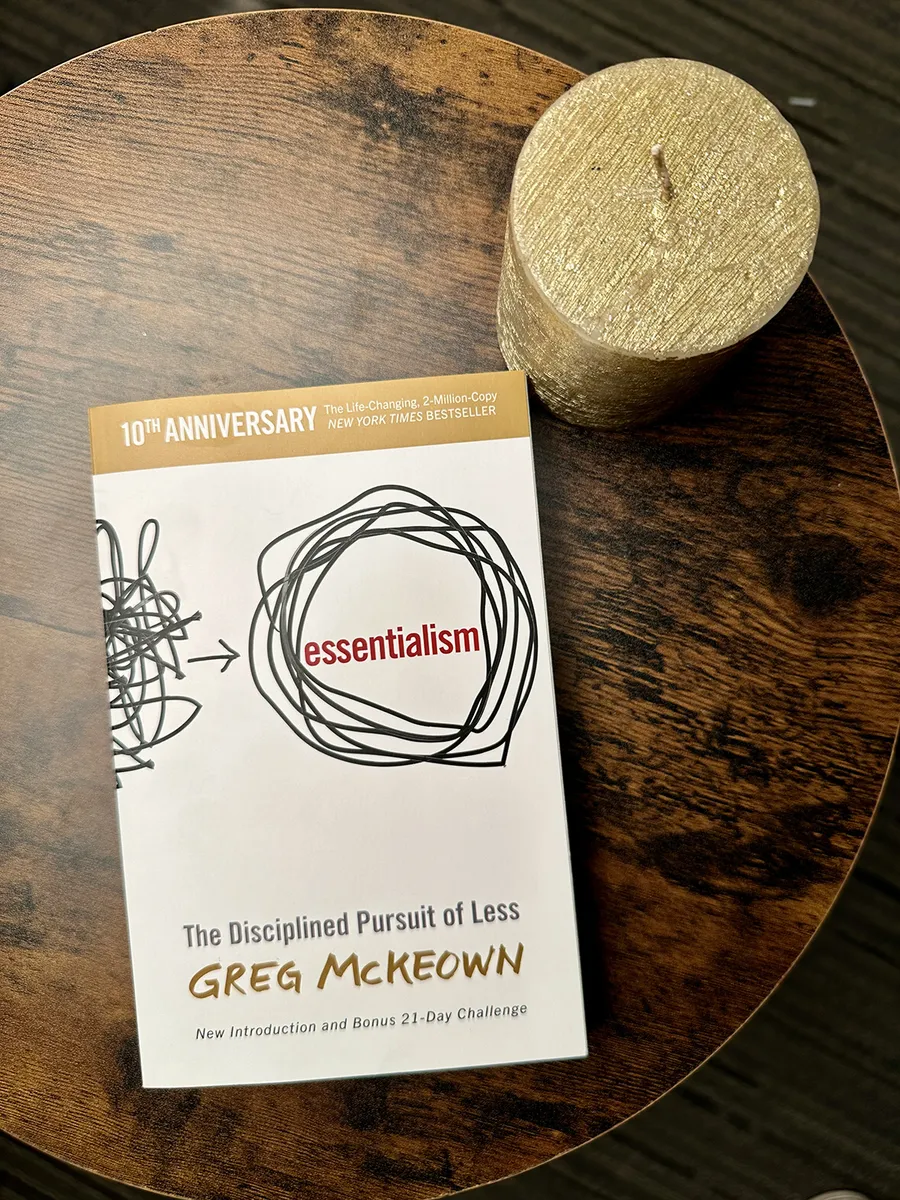
The short answer: what essentialism means
Essentialism follows three moves:
- Explore: create enough space to understand the options.
- Eliminate: remove commitments that do not meet the standard.
- Execute: make the chosen work easier to carry out.
The third step matters. Saying no to five projects does not automatically complete the sixth.
Essentialism is not minimalism for calendars. It is resource allocation.
The official book page describes the same Explore, Eliminate, and Execute sequence. It is an author’s management framework, not a scientific theory. Research can help evaluate narrower claims about competing goals, stopping unattainable goals, or switching attention, but it does not validate the whole branded system.
If everything matters, nothing receives enough
Every yes spends future time, attention, and recovery. The cost is easy to ignore because it is delayed.
A useful decision is not “Is this opportunity good?” Many opportunities are good. Ask:
- What result does it support?
- What will receive less if I accept?
- Would I choose this if it were offered today?
- Does it require my involvement?
- What is the smallest useful version?
Opportunity cost is not pessimism. It is the receipt.
Goal conflict is not only a calendar inconvenience. A meta-analysis of goal conflict and psychological well-being associated greater conflict with more psychological distress and lower positive well-being indicators. The authors also noted that studies defined and measured conflict in different ways.
A systematic review of thirty years of personal-goal research makes a similar methodological point: different research traditions use different concepts and measures. The responsible takeaway is not “fewer goals cure distress.” It is that simultaneous commitments can obstruct one another and deserve explicit review.
Explore: importance is not the same as loudness
Urgency, another person’s confidence, and a polished opportunity can all feel like importance. Before applying a high threshold, ask five slower questions.
1. What result should change?
“Improve the product” or “focus on health” are broad directions. Name the observable change: reduce support response time, publish the onboarding experiment, schedule the clinical appointment, or complete two rehabilitation sessions.
2. What happens if this does not happen now?
Separate real consequences from emotional discomfort. Some work has a legal, health, safety, financial, or relationship cost. Other work is urgent because it arrived with a notification.
3. Why this period?
A temporary window, dependency, or deadline may justify priority. If the answer is only “I have been meaning to,” choose an explicit later review instead of claiming immediate urgency.
4. What will it displace?
Every accepted commitment takes a block from something else: another project, maintenance, sleep, recovery, or relationships. Name that displaced item before saying yes.
5. Whose goal is it?
Ownership is not always individual. Work, care, and family obligations can be legitimate even when they were not freely chosen. The question helps distinguish responsibility from automatic agreement; it does not erase power or duty.
The 90 percent rule is a filter, not mathematics
McKeown suggests rating an option from 0 to 100 and treating anything below 90 as a no.
As literal policy, this is absurd for groceries, admin, and many obligations. As a prompt, it is useful: stop using “somewhat worthwhile” as automatic consent.
Use explicit criteria instead:
| Decision | Criteria |
|---|---|
| New project | Strategic value, time, ownership, learning |
| Social commitment | Relationship, energy, timing, genuine desire |
| Course | Current need, practice opportunity, total cost |
| Feature request | User impact, product direction, maintenance |
Numbers do not remove judgment. They make hidden judgment visible.
The “90 percent rule” is most useful for optional additions, not necessities or morally important maintenance. Food, admin, care, and routine health tasks may never feel like exceptional opportunities. They still deserve capacity.
Eliminate: stopping a goal is not automatically weakness
Essentialism’s removal step becomes more nuanced when a goal is already underway. Stopping can preserve capacity, but sunk cost, identity, promises, and uncertainty make the decision harder than declining a new invitation.
A meta-analysis across 31 samples examined disengagement from unattainable goals and reengagement with alternatives. Associations with quality of life were positive but small: approximately r = 0.08 for disengagement and r = 0.19 for reengagement.
A more recent meta-analytic review of 235 studies distinguishes processes such as disengagement, reengagement, and goal adjustment. This matters because “give up” combines several decisions: reduce effort, release commitment, and choose where capacity goes next.
Before closing a goal, record what changed, what value remains, what obligations must be handled, and whether the capacity has a new direction. An intentional archive is different from avoidance and different again from being forced to stop by circumstances.
Why “if it is not a clear yes, it is a no” is too convenient
Ambivalence can mean low value, but it can also reflect fear, incomplete information, conflicting duties, or a choice whose benefits arrive slowly. A responsible decision may require a small experiment rather than an instant refusal.
Use a third category: not enough evidence yet. Define the cheapest test and a decision date. Read the syllabus before buying the course, interview two users before building the feature, or attend one session before committing to a season.
Saying no without staging a small revolution
“No” can take several forms:
- “I can’t take this on.”
- “I can do X by Friday, but not X and Y.”
- “I’m not the right owner; speak to Alex.”
- “I can review a draft, but I can’t create it.”
- “Not this month.”
A clear trade-off is often more useful than a soft yes followed by delay.
But not everyone has equal freedom to refuse. A junior employee, caregiver, or financially constrained freelancer may face real consequences. Advice about boundaries should not pretend power disappeared because someone read a hardcover book.
Where direct refusal is unsafe, look for scope, sequence, support, or documentation.
This limitation is central, not a footnote. A manager can often eliminate a meeting that a junior employee must attend. A person with savings can decline a client more safely than someone facing rent. Care work and health requirements do not become “nonessential” because they interrupt a focused project.
When refusal is constrained, try a trade-off conversation: “I can complete A by Friday. If B becomes primary, which part of A should move?” Ask for scope, ownership, deadline, or quality to change. Document decisions when power differences make expectations unclear.
Essentialism should increase agency where choice exists, not blame people for constraints they did not create.
Protect buffers before you need them
Essentialism treats buffers as part of execution. Projects take longer, energy varies, and other people reply when they reply.
A plan with no margin works only in the imaginary week used to create it.
Add buffers to:
- deadlines;
- travel;
- difficult conversations;
- recovery after intense work;
- financial commitments;
- transitions between projects.
The goal is not empty efficiency. It is a system that survives ordinary variation.
Buffer is not unused productivity waiting to be reclaimed. It covers uncertainty: preparation, delayed replies, travel, illness, learning, transitions, and recovery. If every buffer is immediately assigned another task, the plan has no buffer.
Use different buffers for different risks. A dependency needs lead time; concentrated work may need recovery; travel needs physical margin; uncertain research needs scope flexibility. One generic “free hour” does not address every kind of uncertainty.
Execute: protect the choice after making it
Selection does not complete work. The chosen priority still needs a visible next action, access to tools, an appropriate block, and protection from repeated switching.
Research on task switching consistently finds switch costs: responses after a switch tend to be slower and more error-prone, and preparation reduces but does not eliminate the cost. A classic review by Monsell summarizes this evidence.
You do not need to eliminate every interruption. Group administrative work where practical, close channels during a bounded focus block, and write the next action before switching away. The point is to reduce avoidable reorientation around the selected work.
Also make the first step smaller than the entire priority. “Write launch strategy” can become “list the three launch decisions and identify the owner of each.” A concrete beginning connects selection with execution.
The trap: making “less” into a new optimization contest
Essentialism can become another identity performance:
- the perfect capsule calendar;
- the perfectly curated reading list;
- aggressive removal of anything without measurable output;
- treating people as interruptions;
- using “focus” to avoid necessary maintenance.
Some important parts of life are repetitive, inefficient, and hard to rank. Care, friendship, play, and community do not always present a quarterly return.
Choosing what matters requires values, not only filters.
The framework can also reward visible projects over invisible maintenance. Paying bills, preparing medication, supporting a family member, and repairing a process may not feel like a bold priority. They still protect the conditions under which chosen work is possible.
A practical priority reset
Make a list of current commitments, then mark each:
- Keep: important and realistically supported.
- Reduce: useful, but too large.
- Delegate: important, but not yours to execute.
- Pause: not now.
- Remove: no longer worth the cost.
For each item you keep, define the next visible action. “Health” is not executable. “Book a dental appointment” is.
Then reserve capacity for rest and maintenance before filling the remaining space.
Add two columns to the audit: consequence of stopping and what this displaces. They prevent an attractive project from appearing free and a quiet maintenance task from appearing valueless.
For uncertain items, add test rather than forcing Keep or Remove. The test should be bounded: one week, one interview, one draft, or one sample session. End it with a decision.
A worked example
Suppose the active list contains a product launch, a new course, weekly exercise, a newsletter, a volunteer role, and overdue medical administration. The launch is the current growth priority; health administration and exercise are maintenance; the course becomes a one-lesson test; the newsletter pauses; the volunteer role requires a scope conversation.
The result is not “only one thing matters.” It is a portfolio in which different commitments have explicit modes and no longer compete as if all were growth projects.
Using essentialism in Flammy
Flammy can help keep chosen priorities visible:
- use a quest for one important outcome;
- keep the daily task list intentionally small;
- archive actions that no longer support the current direction;
- give a task a minimum version instead of pretending every day has full capacity;
- choose rewards that restore energy rather than create another target.
XP should reflect effort on what matters. It should not rescue unnecessary tasks by making them colorful.
1. Choose one current direction
Write the desired result in the season or quest rather than creating a vague daily task called “focus.”
2. Keep two or three actions that influence it
Use observable actions with realistic frequencies. More tasks do not make the direction more important.
3. Archive decorative commitments
Remove tasks kept only because they already exist or generate easy XP. Preserve notes elsewhere when they may matter later.
4. Keep basic life outside the competition
Sleep, food, medication, care, and maintenance should not lose every points contest to the current project. Design them as supports, not rivals.
5. Review the outcome, not only completions
Ask whether the important result changed. If all tasks are checked while the result remains flat, the action–outcome hypothesis may be wrong.
Who essentialism may help
The framework is useful when optional commitments have accumulated, trade-offs remain invisible, or a team needs an explicit conversation about scope. It can also help close goals that no longer fit and protect one temporary growth priority.
It is less useful as a slogan applied to poverty, disability, care obligations, insecure work, or structural overload. In those cases, “choose less” may describe a choice the person does not possess. Practical help may require resources, accommodations, coordination, or policy—not a sharper filter.
The verdict
Essentialism is useful when it changes allocation, not aesthetics.
Keep these questions:
- What result matters now?
- What am I willing to stop or reduce?
- Where do I need margin?
- What is the next action?
- Does this system leave room for a life, not only output?
Doing less is not automatically wise. Doing fewer of the right things, with enough capacity to do them well, often is.
For the planning layer, continue with how to choose a priority goal and how to plan multiple goals.
Make the important work easier to see. Choose one priority, turn it into a concrete quest in Flammy, and remove the actions that no longer deserve a daily vote.
Choose one meaningful quest in Flammy