You open a document, notice a message, answer it, check the news, watch one short video, and return twenty minutes later with the feeling that someone has burgled the room. Everything is still there except the thread of thought.
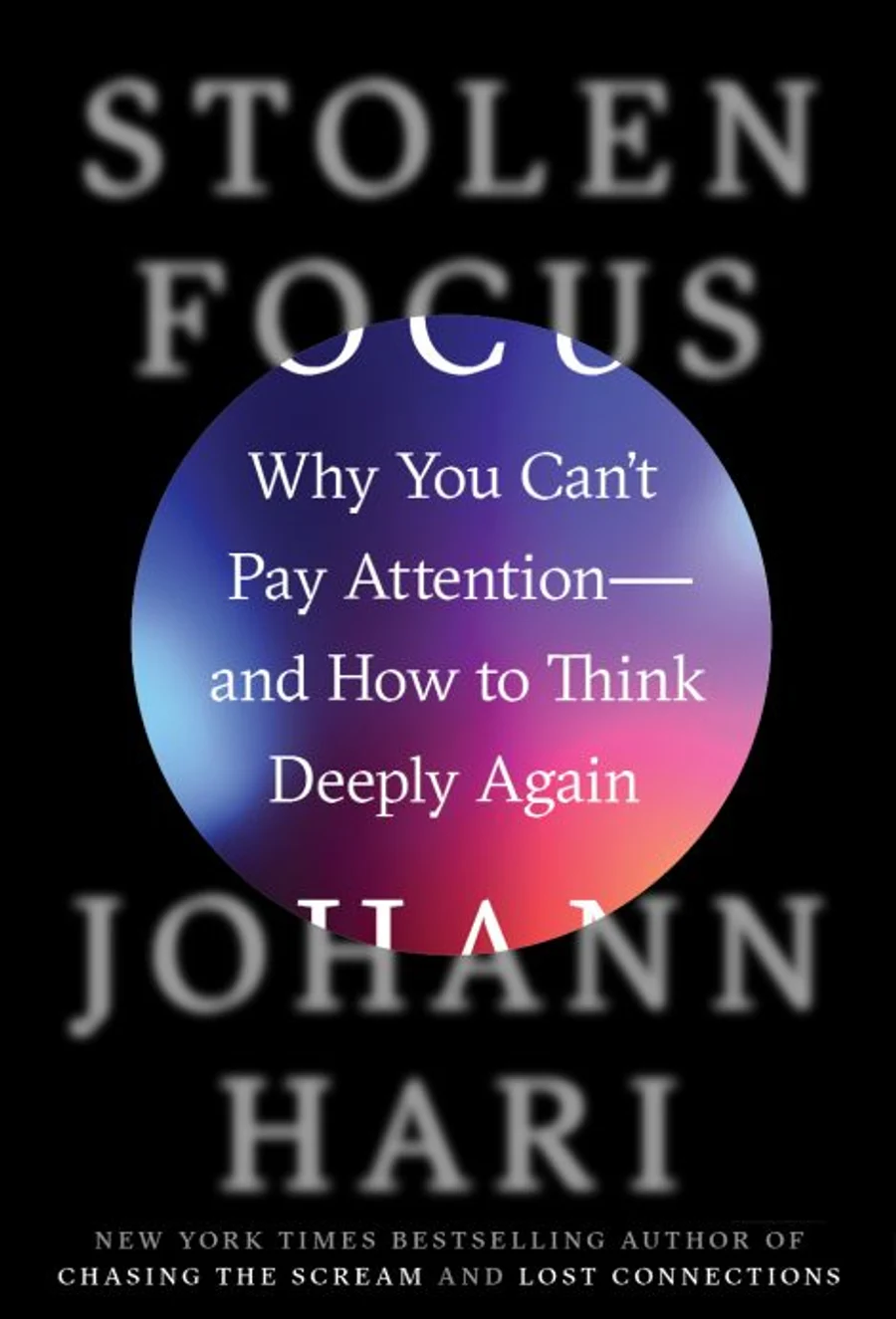
Johann Hari’s Stolen Focus offers a welcome correction: this is not simply a personal failure. Platforms compete for repeated attention, workplaces normalize interruption, and exhausted people are expected to solve the problem with better self-control.
The book is right about the system. The “theft” metaphor is still too tidy. Attention is affected by sleep, stress, task clarity, workload, environment, and meaning. The phone is a major suspect, not the only one.
Attention is not broken forever
Hari groups the problem across several layers:
| Layer | Examples |
|---|---|
| Digital environment | notifications, feeds, rapid novelty, switching |
| Human state | sleep loss, stress, exhaustion |
| Social systems | work norms, platform incentives, education, urban life |
The strength of the book is refusing to reduce everything to screen time. Its weakness is treating evidence of different quality as one confident causal story.
Read the twelve causes as a map of hypotheses, not a diagnosis.
What short-form video research shows
A 2025 meta-analysis covering 71 studies and 98,299 participants found that heavier short-form video use was associated with poorer cognitive outcomes, including attention and inhibitory control.
The associations are meaningful. They are not proof of one-way permanent damage.
Possible explanations include:
- short videos make sustained attention harder;
- people who already struggle with attention use them more;
- the effects reinforce each other;
- sleep, stress, or other factors influence both.
There is no single eight-second “attention span” installed in every adult. Attention changes with task, motivation, state, and environment.
A more defensible conclusion: spending long periods practicing rapid novelty may make slow, effortful activity harder immediately afterward.
Interruptions matter more than raw screen time
Four hours on a phone can include navigation, a family call, reading, work chat, and forty automatic feed checks.
The number does not show the pattern.
Ask:
- How often did I leave the chosen task?
- What triggered the switch?
- How long did it take to resume?
- Was the interruption valuable?
Blocking nonessential notifications has been associated with fewer interruptions, lower strain, and better performance. A message from a doctor and a promotional push are not equal because they occupy the same notification shade.
If an alert does not require action now, it should not decide when you look.
Less mobile internet can help—but compliance is hard
In a 2025 randomized crossover study, blocking mobile internet for two weeks improved subjective well-being, mental health, and sustained attention in the assigned group. The attention effect was modest.
The revealing detail: only a minority of the original sample met the preregistered compliance threshold.
The intervention may help. It is also difficult to live with, especially when maps, banking, communication, and work use the same device.
That is why targeted changes often survive longer than a dramatic detox.
Deleting one app does not fix an unclear task
Attention also leaks through:
- insufficient sleep;
- anxiety;
- too many competing commitments;
- a next step that is not defined;
- work cultures built around instant replies;
- tasks with no meaningful reason behind them.
“Write strategy” is fog. “Draft three points for the opening section” is an action.
If the problem is ambiguity, deleting TikTok removes an escape route without making the work easier to enter.
Run an attention audit
For one day, record switches:
| Field | Example |
|---|---|
| Left | pricing draft |
| Switched to | group chat |
| Trigger | notification banner |
| Cost | seven minutes and lost wording |
| Change | check chat at the top and bottom of the hour |
Group the results:
- external interruptions;
- internal urges;
- unclear tasks;
- low-capacity states;
- genuinely higher priorities.
Now you have settings, not a moral crisis.
A seven-day reset
- Count switches, not only screen minutes.
- Turn off nonhuman notifications.
- add friction to the most automatic feed.
- protect one 25-minute block.
- check whether evening scrolling is taking sleep.
- choose a replacement for the urge.
- keep the one change that helped most.
Do not build a monastery. Build a slightly less interruptible Tuesday.
Using Flammy for attention
Track a practice:
- one 25-minute block without incoming alerts;
- phone outside the bedroom after 11 pm;
- two pages before the first evening scroll;
- write the next action before beginning.
Do not track “be focused.” XP confirms that the setup was practiced; it does not measure cognitive recovery.
The verdict
Stolen Focus is right that attention is not merely an individual character problem. Platform incentives and interruption-heavy systems matter.
The evidence does not support one villain or one cure. Start with the expensive switches, protect sleep, clarify the work, and replace one automatic route.
Attention rarely returns forever. It usually returns for the next 25 minutes. That is enough to begin.
Related reading
- Continue with reducing phone-driven procrastination.
- Continue with short videos and attention.
Replace one automatic scroll with an action you chose. Add the replacement in Flammy, keep a tiny fallback version, and track the practice without punishing distraction.
Replace one scroll in Flammy