The Miracle Morning makes a persuasive offer: complete six personal-development practices before the day has a chance to become complicated.
The hidden requirement is that mornings must first become available. If the routine steals sleep, delays school preparation, or starts a household dispute at 5:30, the miracle has chosen an unusual delivery mechanism.
Hal Elrod’s SAVERS framework is best treated as a menu. Keep the practices that solve a real problem. Leave the rest.
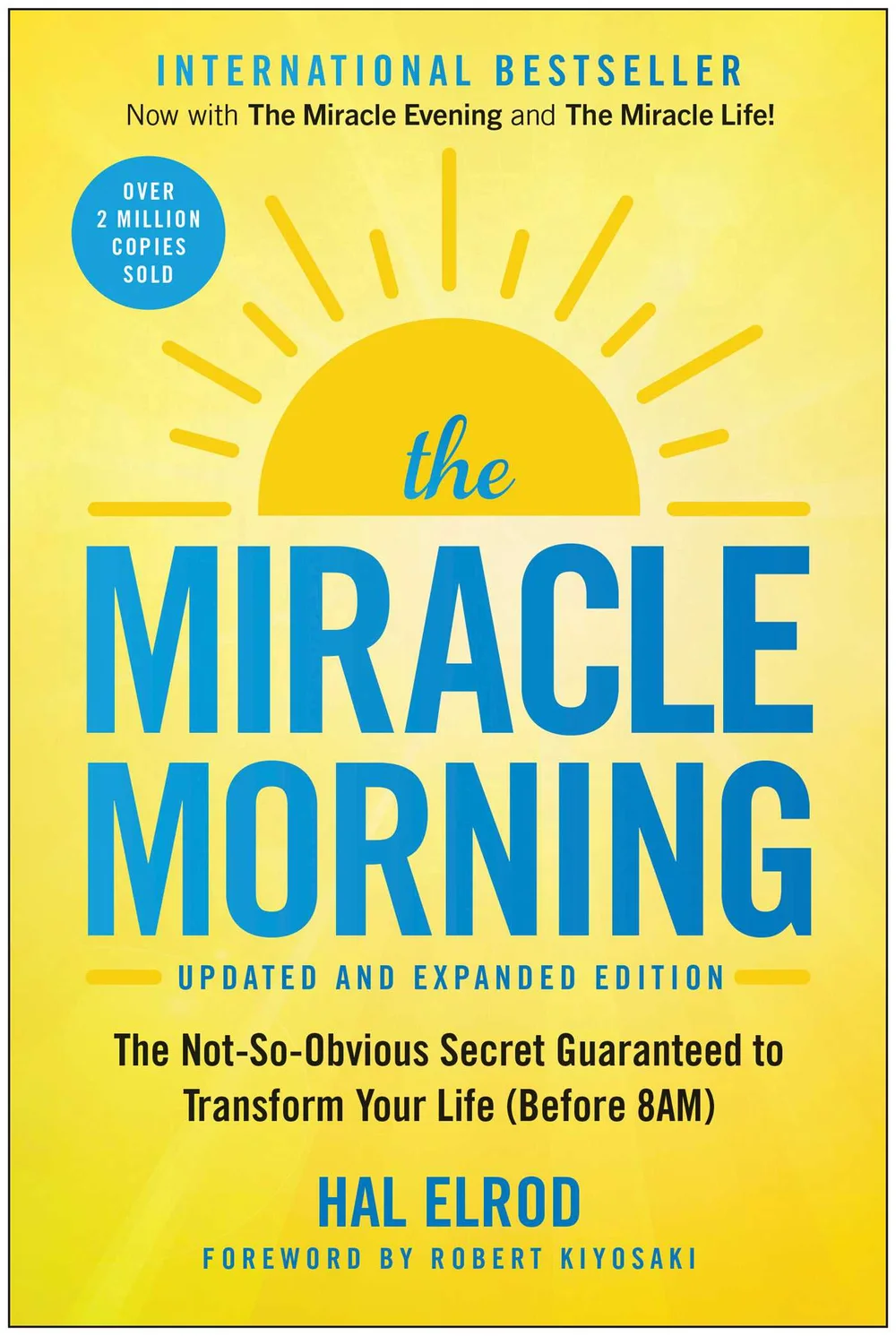
The short answer: SAVERS in plain English
| Letter | Practice | Useful version |
|---|---|---|
| S | Silence | Meditation, breathing, or quiet |
| A | Affirmations | A believable statement tied to action |
| V | Visualization | Rehearse the process, not only the trophy |
| E | Exercise | Movement appropriate to your body |
| R | Reading | Focused learning |
| S | Scribing | Journaling or planning |
The book packages six different practices as one routine. Evidence for one does not automatically validate the exact combination, order, or timing. SAVERS itself has not been established as a clinical intervention, and “morning” is not a scientifically privileged container for all six practices.
The official page for the updated edition even presents a six-minute version. That detail matters: the framework does not have to become an hour-long ceremony. A useful reading is to treat SAVERS as six prompts and select the one or two that address a current problem.
The Miracle Morning does not begin with an earlier alarm
The most important question is not whether you can wake at 5 a.m. It is whether the routine has a safe place in your sleep and household schedule.
Sleep health includes duration, timing, regularity, quality, and the absence of sleep disorders. A consensus recommendation cited by the American Academy of Sleep Medicine says that the average adult should sleep seven or more hours per night on a regular basis. Individual needs and circumstances vary, but taking an hour from sleep to build a “healthy” routine is a poor default.
If you move wake time earlier, move bedtime earlier too and observe whether daytime energy, mood, attention, and safety remain acceptable. Parents, shift workers, people managing illness, and anyone with disrupted sleep may need a later or differently placed routine. A morning framework is not a substitute for assessment and treatment of persistent sleep problems.
The method’s valuable idea is protected intentional time before reactive demands. That time can be ten minutes after waking, a quiet lunch break, or an evening block if that is what reality supports.
Silence: useful when it changes your state
A few minutes of breathing or meditation can create a transition between sleep and incoming demands. It does not require a perfect mind or a meditation identity.
Mindfulness programs do have a research base, but the results are more specific than the broad claim that meditation improves everything. A systematic review and meta-analysis of 47 trials found small-to-moderate improvements in anxiety, depression, and pain. It did not find strong evidence for improvement in several other outcomes, including positive mood, attention, substance use, eating, sleep, and weight.
That does not make two quiet minutes useless. It means the expected result should be modest and personal: perhaps less immediate reactivity or a clearer transition into the day. If silence consistently increases distress or rumination, use another transition and consider appropriate professional support when symptoms are significant.
If silence makes you more agitated, try a short walk, guided audio, or writing down the thoughts competing for attention.
Affirmations: make them believable
“I am an unstoppable success magnet” may not survive contact with your bank app.
More useful:
- “I can send one uncomfortable email before checking the news.”
- “I do not need confidence to begin the first draft.”
- “If I miss today, I will use the small version tomorrow.”
An affirmation works better as a prepared instruction than as compulsory enthusiasm.
There is a reason to avoid unbelievable claims. In two experiments, participants with lower self-esteem felt worse after repeating a positive self-statement, while the benefit for participants with higher self-esteem was small. The study appeared in Psychological Science.
A more defensible affirmation names a value, strategy, boundary, or next action:
- “This conversation matters because I value clarity.”
- “I can feel uncertain and still send the first draft.”
- “If the normal version does not fit, I will use the ten-minute version.”
These sentences do not ask you to believe a grand conclusion. They remind you how you intend to respond.
Visualization: rehearse the process
Imagining only the final success can feel rewarding without improving execution.
In a series of studies, positive fantasies about desired futures predicted lower effort and poorer achievement, while positive expectations based on perceived likelihood related differently to effort. The findings are summarized in work by Oettingen and Mayer. The distinction is useful: enjoying a mental movie of success is not the same as preparing to act.
Instead, visualize:
- opening the document;
- encountering the difficult section;
- using the planned response;
- stopping at a clear point;
- returning the next day.
The useful image includes friction.
An alternative is mental contrasting: name the desired future, identify the internal obstacle, and connect that obstacle to an if–then response. A meta-analysis of mental contrasting with implementation intentions found a small-to-moderate effect on goal attainment, while also noting heterogeneity and possible publication bias.
For example: “I want a finished outline. My likely obstacle is opening messages first. If I sit at the desk after breakfast, then I will write three headings before opening chat.” This visualization rehearses the environment and response rather than treating the final image as progress.
Exercise: movement helps, but morning did not win a contest
Morning movement is convenient for some people, but there is no universal requirement to exercise before breakfast.
A systematic review and meta-analysis comparing morning and evening exercise did not find a clear advantage for morning training across the metabolic outcomes studied. Another review of exercise timing likewise did not establish one universally superior time for health and performance.
Choose a time based on adherence, recovery, safety, facilities, medication, symptoms, and the rest of your schedule. Five minutes of mobility may be a useful morning transition, while a full workout may fit better later. Pain, injury, concerning symptoms, or medical conditions require qualified guidance rather than more commitment to the ritual.
Reading: five pages help only when this is the right text
Reading works when it is active enough to affect something: one idea, one note, one experiment. Collecting highlights at dawn is still collecting.
Choose the material before morning and define what the practice is for. Reading five pages of a relevant chapter and writing one application is different from scrolling book summaries to complete the “R.” If reading is already part of work or another stable routine, you do not need to duplicate it for SAVERS.
The minimum can be one page, but it should still maintain contact with the intended learning. Review whether the reading changes a decision, skill, or understanding—not only whether pages accumulated.
Scribing: writing should help you think
Writing can clarify priorities. A three-line journal may be enough:
- What matters today?
- What might derail it?
- What is the first action?
Journaling research does not support one universal format. A systematic review and meta-analysis reported small-to-moderate effects on mental-health measures, but the included populations, formats, and outcomes varied considerably. An earlier meta-analysis of expressive writing reached a more skeptical conclusion, finding small or absent health effects.
Match the format to the purpose. A planning note can reduce open loops; a decision log can clarify assumptions; expressive writing is a different activity with different risks and evidence. If journaling repeatedly intensifies distress or becomes compulsive reporting, stop or change the practice and seek appropriate support when needed.
Build the shortest routine that works
Start with one problem rather than six practices:
- scattered attention → two minutes of quiet and one written priority;
- stiff body → five minutes of movement;
- no time to learn → ten focused pages;
- difficult project avoidance → write the first action.
Step 1: define the missing morning function
Ask what you want to be different by the end of the routine. “Complete SAVERS” is not an outcome. “Know my first work action,” “move before a sedentary day,” or “begin without checking messages” is easier to test.
Step 2: choose one or two modules
Select the smallest combination likely to influence that function. Quiet plus a written priority may help scattered attention. Movement alone may be enough for stiffness. Do not add a practice because its initial makes the acronym complete.
Step 3: make space without taking it from sleep
Remove or move something before setting an earlier alarm. Prepare clothing, the book, or the document in advance. Include washing, breakfast, care duties, and travel in the time estimate.
Step 4: attach the action to a visible event
Implementation intentions connect a situation to a response. A classic meta-analysis covering 94 independent tests found a positive effect on goal attainment. Write: “After I pour coffee, I will write today’s first action before opening messages.”
The cue must still be noticeable and occur when action is possible. A plan is not magic syntax.
Step 5: define normal and low-capacity versions
Then create two versions:
| Normal day | Low-capacity day |
|---|---|
| 20-minute walk | Walk around the block |
| 10 pages | One page |
| 10-minute journal | One sentence |
The fallback is not cheating. It preserves the route without pretending capacity is constant.
Step 6: test the result for two weeks
Track the action and one relevant outcome. For example, record the routine and whether the first work action became clearer, or track movement and how reliably it occurred. Do not change all modules during the experiment.
After two weeks, keep, change, move, or remove each part. A practice that produces no useful difference is not protected by the popularity of the book.
Sleep is part of the routine
An impressive morning purchased with chronic sleep loss is a bad subscription.
If you move the wake time earlier, move bedtime too. Track daytime energy, mood, and concentration—not just whether you completed the ritual.
Morning routines are useful because they can protect attention. Sleep deprivation removes the attention you were trying to protect.
Also protect relationships and household logistics. A ritual that requires everyone else to remain silent or absorb additional morning work has costs that should be included in the evaluation.
Using SAVERS in Flammy
Do not add all six practices on day one. Choose one or two:
- a concrete action;
- a small minimum;
- a stable cue;
- a review after two weeks.
Flammy can show repetitions and provide immediate XP. It cannot tell whether an affirmation is meaningful or whether your morning is better than the rest you gave up.
Use one task per genuinely independent behavior only when that detail helps. Otherwise, track a compact baseline such as “Two quiet minutes and one written priority after coffee.” Set the real schedule, add a reduced version, and review the result rather than chasing equal XP for all six letters.
Who may benefit—and who should skip it
The framework may help someone who has enough sleep, wants a deliberate transition, and enjoys one or two SAVERS practices. It may also help as a temporary experiment during a stable period.
Skip or relocate it when earlier waking reduces sleep, mornings already contain non-negotiable care or travel, the six-part checklist creates anxiety, or the chosen practices do not address a real need. People managing significant sleep, mood, anxiety, pain, or medical symptoms should not treat a self-help routine as diagnosis or treatment.
The verdict
The Miracle Morning is a good menu presented as a complete breakfast.
Keep:
- intentional time before reactive demands;
- a short transition into the day;
- process-focused planning;
- a routine small enough to survive ordinary mornings.
Skip the idea that all six practices, early in the morning, are required for transformation.
The strongest version of the method is smaller than the brand promise: protect sleep, choose one useful practice, connect it to a real cue, and check whether life actually improves.
For a simpler design, read morning routine and if–then plans for habits.
Build a morning routine that fits your actual morning. Pick one useful practice, add a small fallback version, and track the effect for two weeks.
Build a realistic morning in Flammy