The 5 AM Club offers a beautifully simple trade: wake up while everyone else is asleep and collect an hour of exercise, reflection, learning, and quiet superiority.
The trade works if you also go to bed earlier. If you finish work at midnight and borrow the hour from sleep, you have not created time. You have moved the invoice to tomorrow afternoon.
Robin Sharma’s best idea is not 5:00. It is protecting the first part of the day from incoming demands and deciding in advance what deserves your freshest attention.
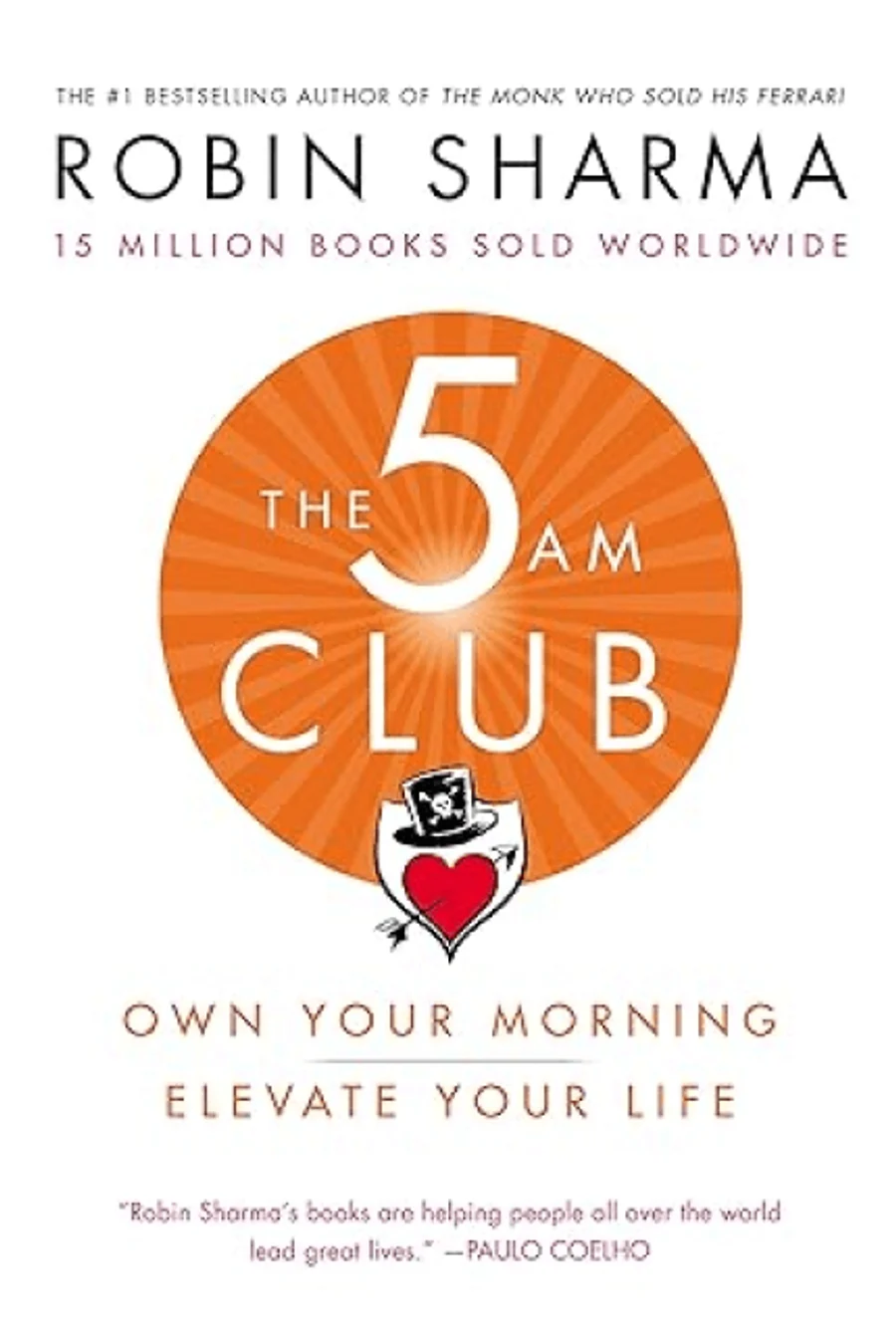
What the method actually asks you to do
Sharma’s “Victory Hour” uses a 20/20/20 structure:
| Time | Block | Purpose |
|---|---|---|
| 5:00–5:20 | Move | Exercise and raise energy |
| 5:20–5:40 | Reflect | Journal, plan, meditate, or think |
| 5:40–6:00 | Grow | Read or practice a skill |
All three activities can be useful. What has not been established is that:
- 5 am is uniquely effective;
- twenty minutes is the ideal dose;
- everyone benefits from the same order;
- the combination works as a special scientific protocol.
Treat it as a menu, not a medical prescription.
Five in the morning does not manufacture time
Adults are generally advised to get at least seven hours of sleep on a regular basis. Individual needs vary, but the arithmetic remains rude.
If you wake at five, you need a bedtime that makes five sustainable. “I will be in bed by ten” is not the same as actually falling asleep by ten, especially when family, work, commuting, or a busy nervous system have other plans.
The first question is not “Can I force myself up?” It is:
What would have to change in the evening for this wake time to be honest?
If the answer is “nothing, I will simply sleep less,” the experiment is already badly designed.
Chronotype is not an excuse or a setting you can ignore
People differ in their preferred timing for sleep and activity. Age, light exposure, routine, work schedules, and biology all contribute.
A later chronotype forced into an early social schedule can experience social jetlag: a mismatch between internal timing and required timing. That does not mean schedules can never shift. It means the cost is not identical for everyone.
Early waking is a reasonable experiment when:
- you can move bedtime too;
- mornings are genuinely quieter;
- you feel alert after waking;
- the routine improves the rest of the day.
It is a poor bargain when:
- you rely on repeated snoozing;
- daytime sleepiness keeps rising;
- concentration, mood, or training suffers;
- weekends become emergency sleep recovery.
The useful part of 20/20/20
Move
Exercise has broad benefits, but research does not identify one universally superior time of day. Morning movement may work because it is protected, not because muscles can read clocks.
Reflect
Journaling or planning can reduce morning ambiguity. The useful output is usually small: one priority, one concern written down, one next action.
Grow
Twenty minutes of learning is enough to create regular contact with a skill. It is not enough to guarantee mastery, especially if “learning” means highlighting a book while thinking about email.
You can shorten or reorder all three blocks. A ten-minute routine you keep is more useful than an hour-long identity project that survives four weekdays.
A better two-week experiment
Before starting, record your usual sleep and daytime energy for three days.
Then:
- Move bedtime and wake time by 15–30 minutes, not two heroic hours.
- Keep enough time for sleep.
- Choose one morning action that matters.
- Prepare the environment the night before.
- Track wake time, sleep duration, daytime sleepiness, and the action.
- Review after fourteen days.
The success criteria should be:
- the action happened more consistently;
- the rest of the day did not get worse;
- the schedule did not require constant recovery.
Waking at 5:00 while becoming unbearable by 2:00 is not a productivity win.
Using the idea in Flammy
Do not track “wake up at 5” as if the clock itself were the goal. Track the action the early hour is supposed to protect:
- write for 20 minutes;
- take a short walk;
- plan the day;
- study one lesson.
Add a minimum version for rough mornings and watch the pattern for two weeks. Flammy can show whether you repeated the action. Your sleep and daytime functioning tell you whether the schedule deserves to stay.
The verdict
The 5 AM Club is a compelling wrapper around a useful idea: protect time before the world starts making requests.
Keep the protected hour. Question the sacred number. Sleep first, choose one valuable action, and test the full-day result.
Your best morning may start at 5:00. It may start at 7:30. The alarm clock does not issue achievement certificates.
Related reading
- Continue with building a realistic morning routine.
- Continue with planning rest without treating it as a reward.
Test a calmer morning without promising to wake at five forever. Add one meaningful action in Flammy, keep a small fallback version, and review the pattern after two weeks.
Test your morning routine in Flammy